Weather Alert in Michigan
Hydrologic Outlook issued February 17 at 9:43AM EST by NWS Grand Rapids MI
AREAS AFFECTED: Allegan, MI; Barry, MI; Calhoun, MI; Clinton, MI; Eaton, MI; Ingham, MI; Ionia, MI; Jackson, MI; Kalamazoo, MI; Kent, MI; Muskegon, MI; Ottawa, MI; Van Buren, MI
DESCRIPTION: ESFGRR Steady melting of snow and ice over the last week has begun to cause rivers to rise across the area. Several chances for rain this week will add to these rises. Based on current expected rainfall, no significant flooding is expected on West Michigan rivers, though typical spring water level rises within the river channels will happen. Meanwhile, river ice has weakened significantly over the last week, and as water levels rise any remaining ice will likely be broken and start to move downstream. This creates the possibility for formation of a few ice jams. Ice jams tend to form in the same places repeatedly, so special attention should be paid in the Comstock Park (Kent County) area as well as the Robinson Township (Ottawa County) area along the Grand River. Anyone living or working near West Michigan rivers should pay extra attention this week as water levels rise. Have a plan to monitor and respond if flooding develops unexpectedly. Monitor the latest conditions at https://water.noaa.gov
INSTRUCTION: N/A
Want more detail? Get the Complete 7 Day and Night Detailed Forecast!
Current U.S. National Radar--Current
The Current National Weather Radar is shown below with a UTC Time (subtract 5 hours from UTC to get Eastern Time).

National Weather Forecast--Current
The Current National Weather Forecast and National Weather Map are shown below.

National Weather Forecast for Tomorrow
Tomorrow National Weather Forecast and Tomorrow National Weather Map are show below.

North America Water Vapor (Moisture)
This map shows recent moisture content over North America. Bright and colored areas show high moisture (ie, clouds); brown indicates very little moisture present; black indicates no moisture.

Weather Topic: What are Altocumulus Clouds?
Home - Education - Cloud Types - Altocumulus Clouds
 Next Topic: Altostratus Clouds
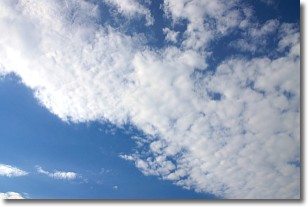
Similar to cirrocumulus clouds, altocumulus clouds are
characterized by cloud patches. They are distinguished by larger cloudlets
than cirrocumulus clouds but are still smaller than stratocumulus clouds.
Altocumulus clouds most commonly form in middle altitudes (between 2 and 5 km)
and may resemble, at times, the shape of a flying saucer.
These uncommon formations, called altocumulus lenticularis, are created by uplift
in the atmosphere and are most often seen in close proximity to mountains.
Next Topic: Altostratus Clouds
Weather Topic: What are Cirrocumulus Clouds?
Home - Education - Cloud Types - Cirrocumulus Clouds
 Next Topic: Cirrostratus Clouds
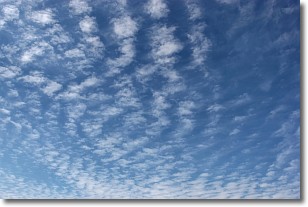
Cirrocumulus clouds form at high altitudes (usually around 5 km)
and have distinguishing characteristics displayed in a fine layer of
small cloud patches. These small cloud patches are sometimes referred to as
"cloudlets" in relation to the whole cloud formation.
Cirrocumulus clouds are formed from ice crystals and water droplets. Often, the
water droplets in the cloud freeze into ice crystals and the cloud becomes a
cirrostratus cloud. Because of this common occurrence, cirrocumulus cloud
formations generally pass rapidly.
Next Topic: Cirrostratus Clouds
Current conditions powered by WeatherAPI.com